Science communication is often seen as the realm of complex theories and highbrow discussions, something reserved for academics and experts. But should it really stay confined to the academic circles? Absolutely not. It is essential for scientific discoveries and progress to reach beyond labs and lecture halls, into the public domain. It needs to be shared so we can all understand them and use that knowledge. As Sir Mark Walport stated, “Science isn’t complete until it’s communicated.” This isn’t just a quote; it’s a call to action.
We are bombarded with information every single day, and sorting out what’s real science from what’s pseudoscience is a tough task. We need to be truly concerned about how false and misleading information can affect our decisions. This is exactly where science communication plays a crucial role. It involves providing the public with clear explanations to help them navigate the complex landscape of information, making them not just absorbers of information. By talking science clearly and making those complicated ideas less intimidating, it facilitates people’s ability to identify reliable information. But for science to be truly effective in the public space, it needs to be shared in a way that resonates. Ultimately, science communication is not just giving information; it’s about empowering common people, strengthening communities, and building a society that embraces and utilizes scientific knowledge to tackle major challenges and improve everyone’s lives.
From social media campaigns and podcasts to public talks, interactive workshops and documentaries, there are many ways to bridge the gap between science and society. But how can we make complicated ideas not just clear, but also exciting and entertaining? This is where the Science Slam comes in, offering a dynamic and fresh approach to science communication. The concept of Science Slam first took shape in Germany in the mid-2000s, inspired by the format of poetry slams. Just like poets present their work in front of a live audience, young scientists were given the stage to present their research. The difference? They had to do it in 10 minutes or less, without heavy slides or complicated explanations. It shatters the image of a stereotypical scientific presentation. Instead, they are encouraged to use storytelling, humor, and creativity to connect with the audience and compete for the top spot.
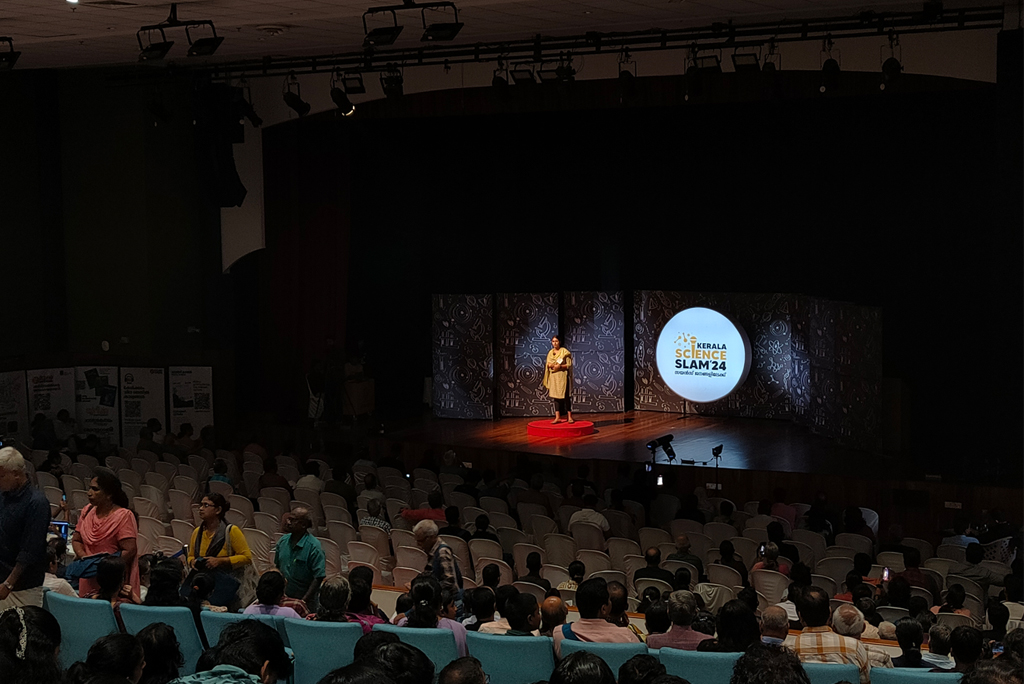
The first official Science Slam took place in Darmstadt, Germany in 2006 and from there, the idea spread quickly across Europe and beyond. Today, Science Slams are held around the world from university halls to public festivals bringing researchers and the public together in a shared space of curiosity and fun. Kerala hosted its first Science Slam in 2024, featuring presentations on diverse topics. These included the science of sonar, a genetic study of the African snail, the use of nanotechnology for cancer treatment, the application of AI to save diabetics from eye diseases and many other fascinating subjects.
Here’s a breakdown of what makes Science Slam unique:
- Quick and to the Point: Each presenter gets just 10 minutes to explain their work. This time limit forces them to be concise and get straight to what matters.
- Made for Everyone: The talks are designed for a general audience, so no prior scientific knowledge is needed. The aim is to make science understandable for anyone, regardless of their scientific background.
- Creativity is Key: This is where the ‘slam’ part comes in! Researchers are encouraged to ditch traditional academic presentation styles and instead use their imagination. This involves employing creative narration to tell a compelling story about their research, incorporating humor, personal anecdotes, or vivid descriptions. Presenters can also use props, such as everyday items or custom-made models, to illustrate complex concepts, and even perform live demonstrations to capture the audience’s attention and showcase scientific principles in an engaging way.
At its core, this involves a powerful mission: To enhance the science communication skills of researchers, empower researchers to communicate directly with the public confidently, and bring the benefits of science closer to the people. It’s about popularizing science by making it accessible, engaging, relevant, and ultimately, about building a scientifically literate society that values and understands the role of science in daily life.
Challenges and Questions
Of course, there are challenges. How do we scale Science Slam to reach wider audiences? How do we encourage more researchers from diverse fields to participate? How do we measure the success of Science Slam in improving scientific literacy?
References
- Borowiec, B. G. (2023). Ten simple rules for scientists engaging in science communication. PLoS Computational Biology, 19(7), e1011251. https://doi.org/10.1371/journal.pcbi.1011251
- Goldstein, C. M., Murray, E. J., Beard, J., Schnoes, A. M., & Wang, M. L. (2020). Science communication in the age of misinformation. Annals of Behavioral Medicine, 54(12), 985–990. https://doi.org/10.1093/abm/kaaa088